
Res Judicata in Property Disputes: Subsequent Co-Ownership Claims Barred After Final Judgment on Ownership
Issue
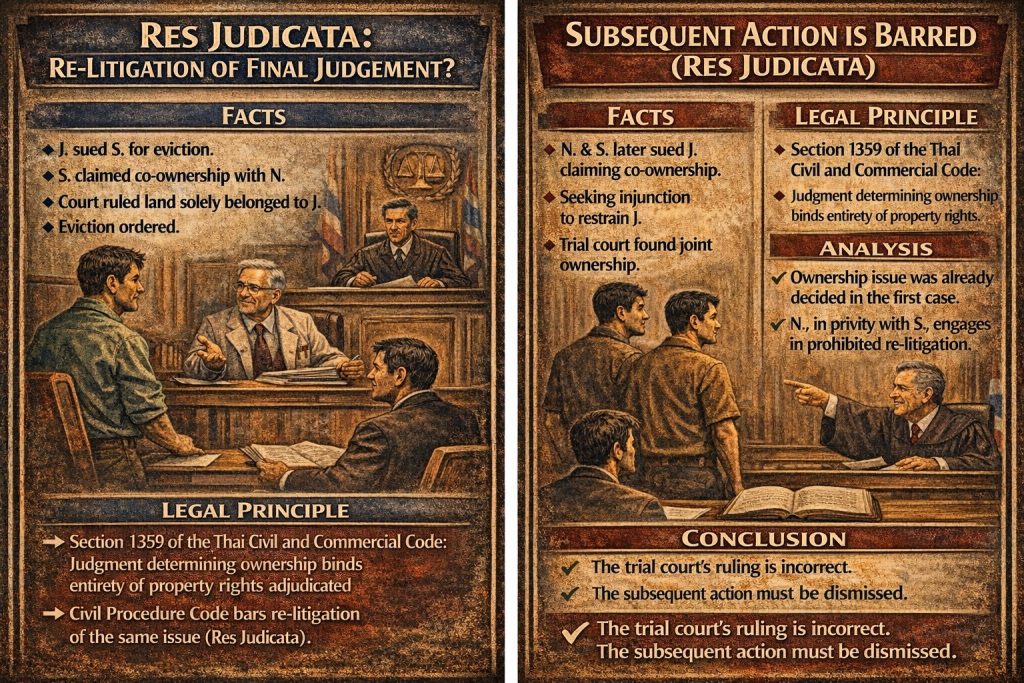
Whether the subsequent action filed by N. and S. against J., seeking an injunction and declaration of co-ownership, is barred as a re-litigation (res judicata) following the prior final judgment.
Facts
J. filed an action against S. for eviction, alleging unlawful occupation of the disputed land. S. defended on the ground of co-ownership with N. The court rendered a final judgment that the land exclusively belonged to J., ordering eviction.
Subsequently, N. and S. jointly filed a new action against J., asserting co-ownership over the same land and seeking to restrain J. from interference. The trial court in the latter case ruled that the land was jointly owned and granted the injunction.
Legal Principle
Under Section 1359 of the Civil and Commercial Code, a judgment determining ownership binds the entirety of the property rights adjudicated.
Additionally, under the Civil Procedure Code, a final judgment on the merits precludes re-litigation of the same issue between the same parties or their privies (principle of res judicata).
Analysis
S.’s defense in the first case—claiming co-ownership—constituted an assertion of proprietary rights. The court’s final judgment rejecting such claim conclusively determined ownership.
N., as an alleged co-owner, stands in privity with S. Therefore, the issue of ownership has already been finally adjudicated. The second action reintroduces the same issue and is thus barred as a repetitive claim.
Conclusion
The judgment of the trial court in the latter case is incorrect. The action constitutes a prohibited re-litigation (res judicata), and the claim should be dismissed.