
Validity and Enforceability of a Compromise Agreement in Succession Involving a Minor Heir
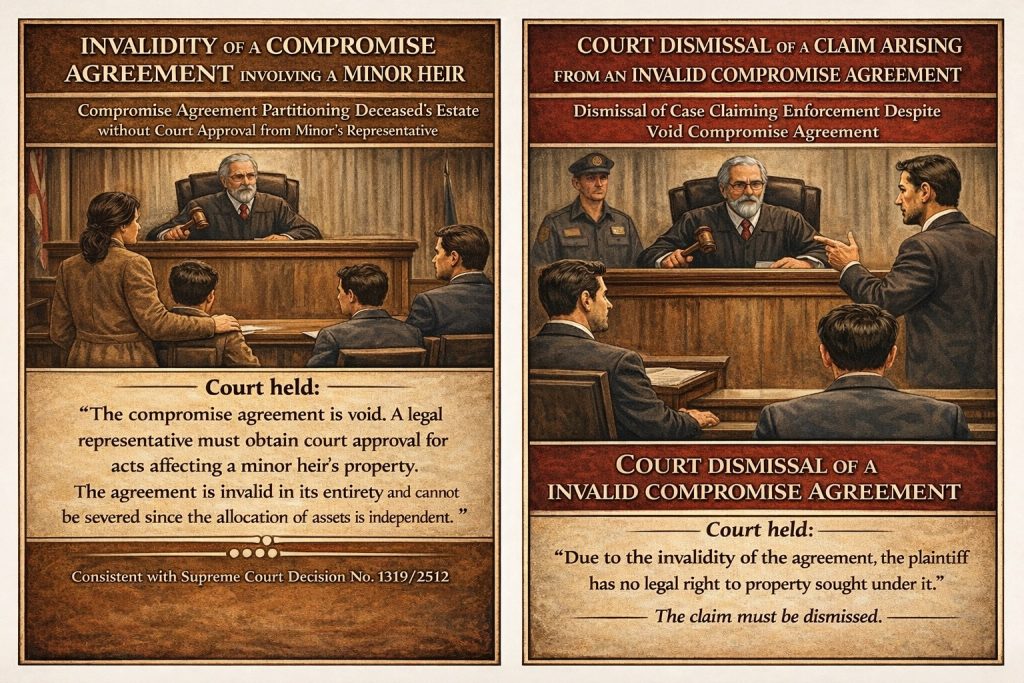
Mr. Piset (the deceased) was survived by his wife, Mrs. Aek, and their three children: Mr. Tho (25 years old), Mr. Tri (22 years old), and Mr. Jattawa (16 years old, a minor). Following his death, all heirs entered into a compromise agreement to partition the estate. Under the agreement, Mrs. Aek was to receive land and a house; Mr. Tho, agricultural land; Mr. Tri, land and a textile factory; and Mr. Jattawa, land and a commercial building.
Subsequently, Mr. Tho failed to transfer the land and textile factory to Mr. Tri as agreed. Mr. Tri therefore filed a claim seeking enforcement of the agreement.
Legal Analysis:
The compromise agreement is void. Although the heirs mutually agreed to divide the estate, one of the parties, Mr. Jattawa, was a minor. Under Section 1574 of the Civil and Commercial Code, a legal representative exercising parental power must obtain court approval before entering into a juristic act affecting a minor’s property. In this case, Mrs. Aek, acting as the legal representative, failed to obtain such approval.
As a result, the agreement is invalid in its entirety. Furthermore, the agreement cannot be severed to preserve only the valid portions, since the allocation of assets among heirs is interdependent and constitutes an indivisible arrangement. This is consistent with Supreme Court Decision No. 1319/2512.
Conclusion:
The Court should dismiss the claim. The compromise agreement is void and unenforceable; therefore, Mr. Tri has no legal right to demand transfer of the disputed property.