
Jurisdiction of a Single Judge in Adjudicating Criminal Theft with an Attached Civil Restitution Claim in the Absence of the Presiding Bench
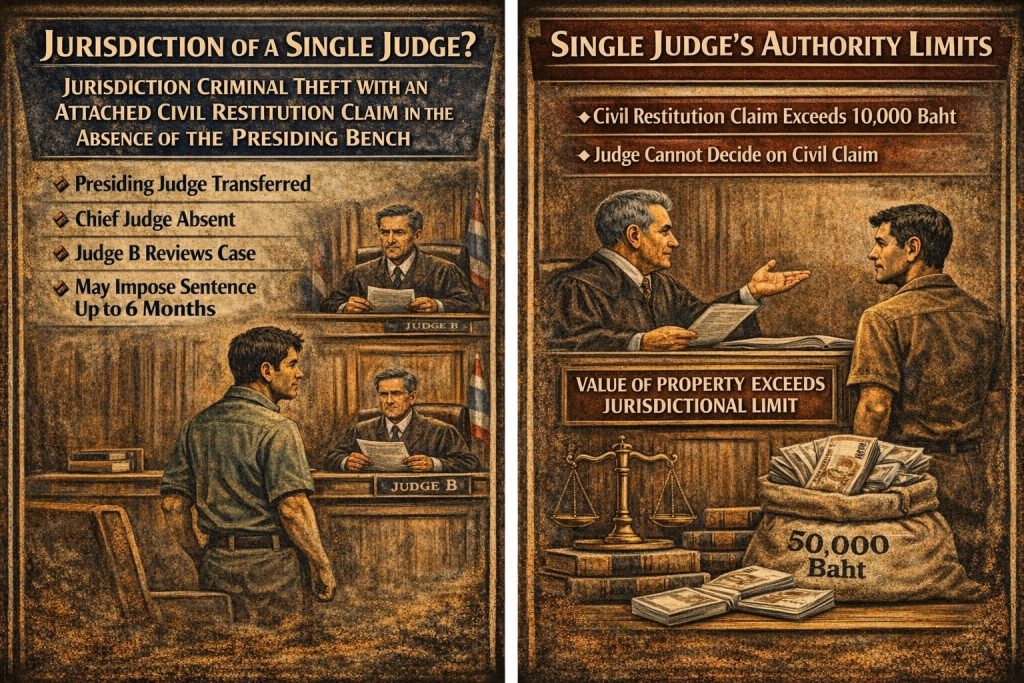
Whether a single remaining judge at a District Court may lawfully adjudicate a criminal case involving theft under Section 334 of the Thai Penal Code, including an ancillary civil claim for restitution valued at 50,000 Baht.
Facts:
The public prosecutor filed a complaint against the defendant for theft and requested both criminal punishment and restitution of the stolen property (valued at 50,000 Baht). Initially, Judge A presided over the trial but was transferred before judgment. The head of the court was absent on official duty, leaving only Judge B, who had not previously participated in the trial proceedings.
Legal Analysis:
This matter constitutes a criminal case with a civil claim attached. Under the applicable provisions of the Judicial Service Act and relevant procedural law, where the presiding judge is unavailable and the Chief Judge is absent, the remaining judge may act in a temporary capacity.
Pursuant to Section 9 (final paragraph) and Section 11(4)(1), Judge B is empowered to review the case file and render judgment independently, provided the case falls within the jurisdiction of a single judge panel. In criminal matters, a single judge may impose a sentence of imprisonment not exceeding six months.
However, the civil claim for restitution constitutes a separate component. Given that the value of the property exceeds the monetary threshold typically allowed for adjudication by a single judge in civil matters, Judge B lacks jurisdiction to decide the civil aspect of the case.
Conclusion:
Judge B may lawfully proceed to adjudicate the criminal charge and impose a sentence within the statutory limit (not exceeding six months’ imprisonment). However, Judge B does not have the authority to rule on the civil claim for restitution due to jurisdictional limitations concerning the value of the property.