
Criminal Acquittal and Subsequent Civil Claim for Restitution: Non-Application of Res Judicata in Thai Law
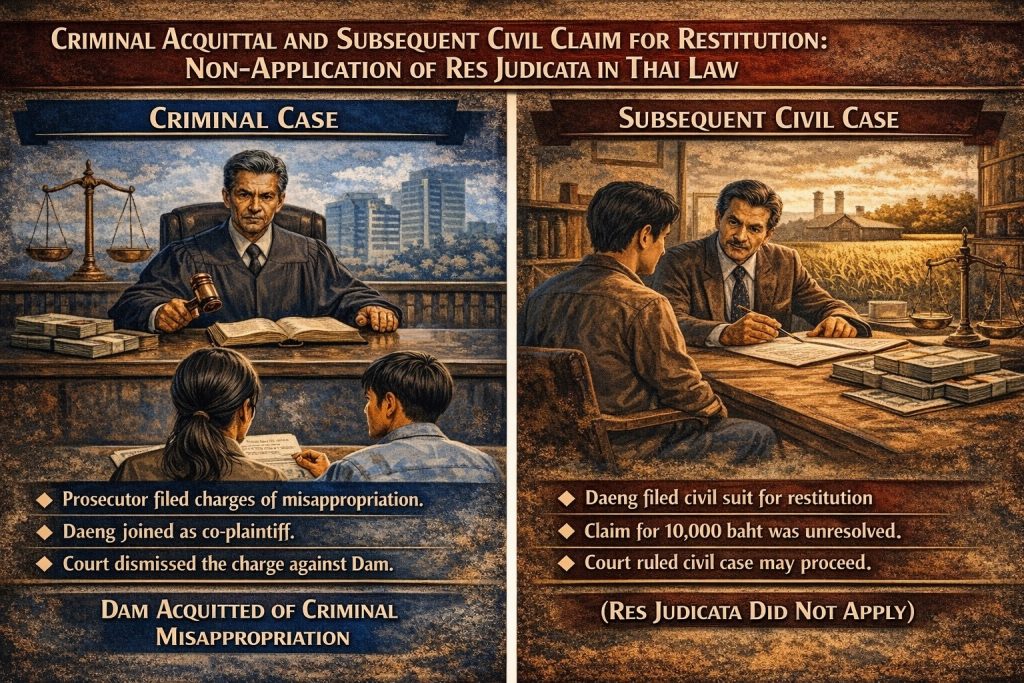
Case Summary (Structured Legal English)
The public prosecutor filed a criminal action against Dam, alleging misappropriation of funds belonging to Daeng, and requested both criminal punishment and restitution.
Daeng subsequently petitioned to join the case as a co-plaintiff, which the court permitted.
Upon trial, the Court of First Instance found that Dam did not commit misappropriation and rendered a judgment dismissing the case.
Daeng filed an appeal against such judgment.
During the pendency of the appeal, Daeng initiated a separate civil action against Dam, seeking compensation for the same amount.
Dam raised a defense that the civil action constituted res judicata (duplicate litigation).
Before the Civil Court rendered any judgment, Dam died, and the appellate court ordered the case struck out of the docket.
Dam’s heir then entered an appearance in the civil case and requested the court to determine the preliminary issue.
Legal Issue
Whether the civil action constitutes res judicata in light of the prior criminal proceedings.
Holding
The Court should order the case to proceed.
Legal Reasoning
The civil action does not constitute res judicata, as neither the Court of First Instance nor the appellate court made a determination regarding the obligation to return the sum of 10,000 baht.
Furthermore, the civil action is based on a claim in tort, not identical to the criminal charge of misappropriation.
Thus, the causes of action are not the same.
(See Supreme Court Decision No. 361/2516)