
Application for Reconsideration after Default Judgmen
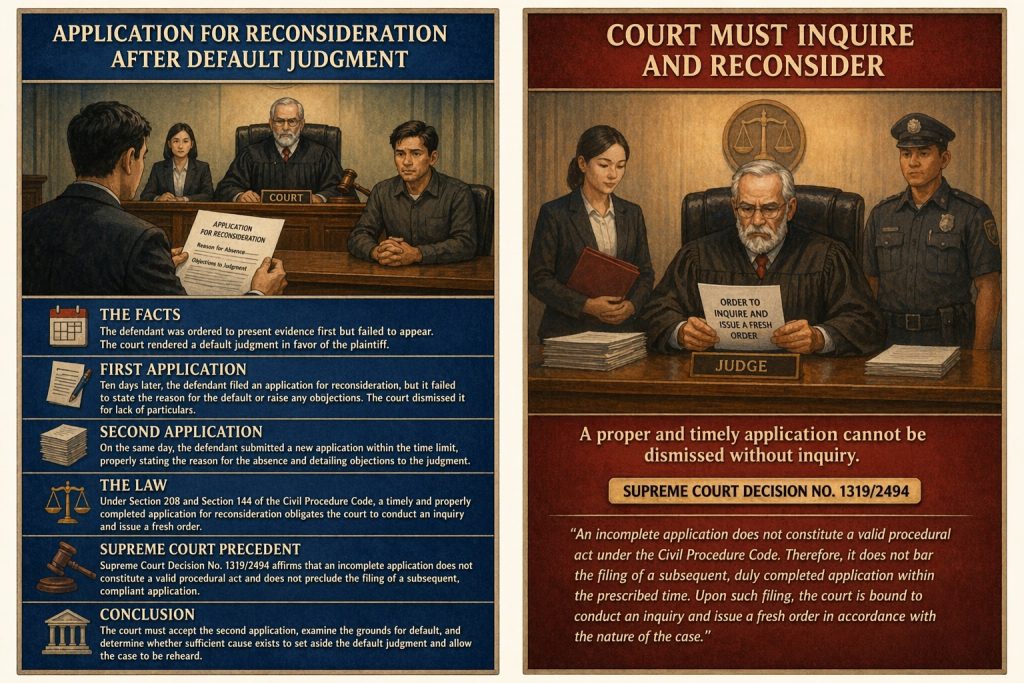
In a civil action where the court ordered the defendant to present evidence first, the defendant failed to appear on the appointed hearing date. Consequently, the court rendered a default judgment in favor of the plaintiff.
Ten days thereafter, the defendant filed an application for reconsideration. However, the initial application failed to state the reason for the default or to raise any substantive objections against the judgment. The court dismissed such application due to lack of particulars.
On the same day, the defendant submitted a new application, this time providing detailed grounds explaining the absence and contesting the judgment.
Legal Analysis:
Although the defendant had previously submitted an incomplete application, such submission does not constitute a valid procedural act under the Civil Procedure Code. Therefore, it does not preclude the filing of a subsequent, properly completed application within the prescribed time limit.
Pursuant to Section 208 and Section 144 of the Civil Procedure Code, where an application for reconsideration is filed within the statutory period and complies with all legal requirements, the court is obligated to conduct an inquiry and issue a fresh order based on the merits of the case.
This principle is affirmed by Supreme Court Decision No. 1319/2494.
Conclusion:
The court must accept the second application, proceed to examine the grounds for default, and determine whether sufficient cause exists to set aside the default judgment and allow the case to be reheard.