Admissibility of an Appeal in a Low-Value Civil Case
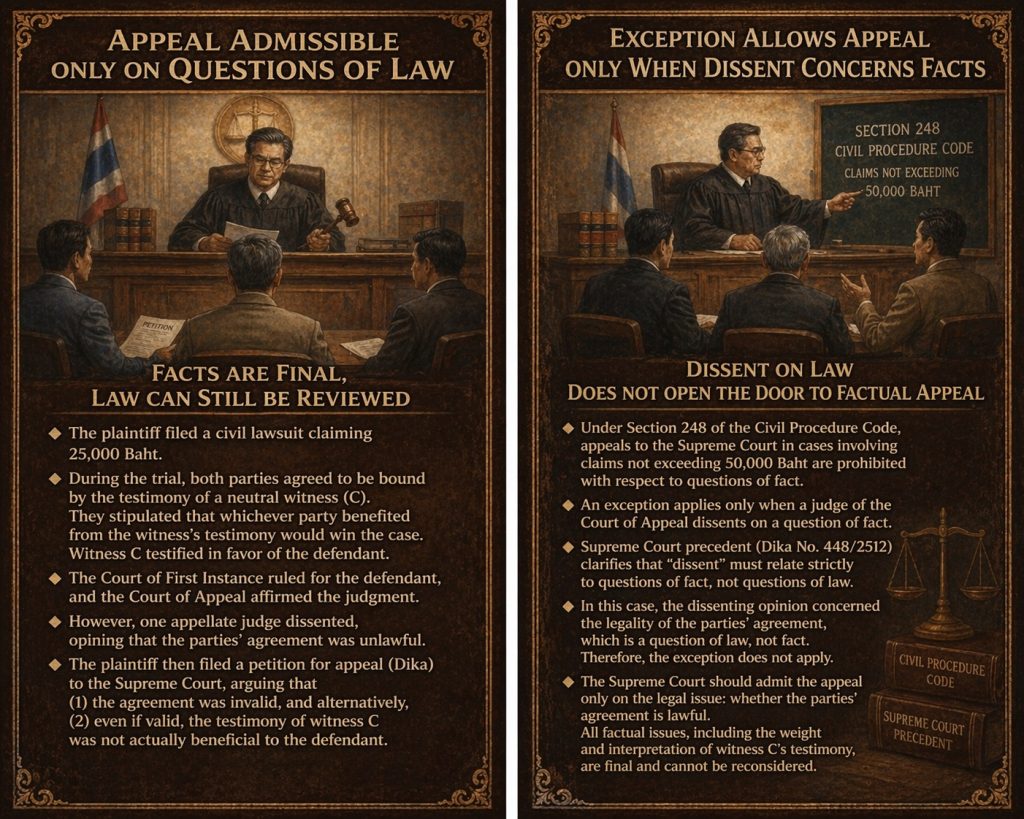

In this case, the plaintiff initiated a civil action with a claimed value of 25,000 Baht. During trial, the parties mutually agreed to be bound by the testimony of a neutral witness (C), stipulating that whichever party benefited from such testimony would prevail. The witness ultimately testified in favor of the defendant. The Court of First Instance rendered judgment accordingly, and the Court of Appeal affirmed the decision.
However, one appellate judge expressed a dissenting opinion, stating that the parties’ agreement (the “challenge”) was unlawful. The plaintiff subsequently filed a petition to the Supreme Court (Dika), arguing both that the agreement was invalid and, alternatively, that even if valid, the testimony of witness C should not be deemed favorable to the defendant.
Pursuant to Section 248 of the Civil Procedure Code, in cases where the amount in dispute does not exceed 50,000 Baht, an appeal to the Supreme Court on questions of fact is prohibited, unless there is a dissenting opinion among the judges of the Court of Appeal.
Importantly, Supreme Court precedent (Dika No. 448/2512) clarifies that such dissent must relate strictly to questions of fact, not questions of law.
In the present case, the dissenting opinion concerns the legality of the parties’ agreement, which constitutes a question of law, not fact. Therefore, the exception allowing an appeal on factual issues does not apply.
Pursuant to Section 248 of the Civil Procedure Code, in cases where the amount in dispute does not exceed 50,000 Baht, an appeal to the Supreme Court on questions of fact is prohibited, unless there is a dissenting opinion among the judges of the Court of Appeal.
Importantly, Supreme Court precedent (Dika No. 448/2512) clarifies that such dissent must relate strictly to questions of fact, not questions of law.
In the present case, the dissenting opinion concerns the legality of the parties’ agreement, which constitutes a question of law, not fact. Therefore, the exception allowing an appeal on factual issues does not apply.