
Invalid Confession and Burden of Proof: Acquittal Where Defendant Denies Essential Elements Despite Conditional Admission
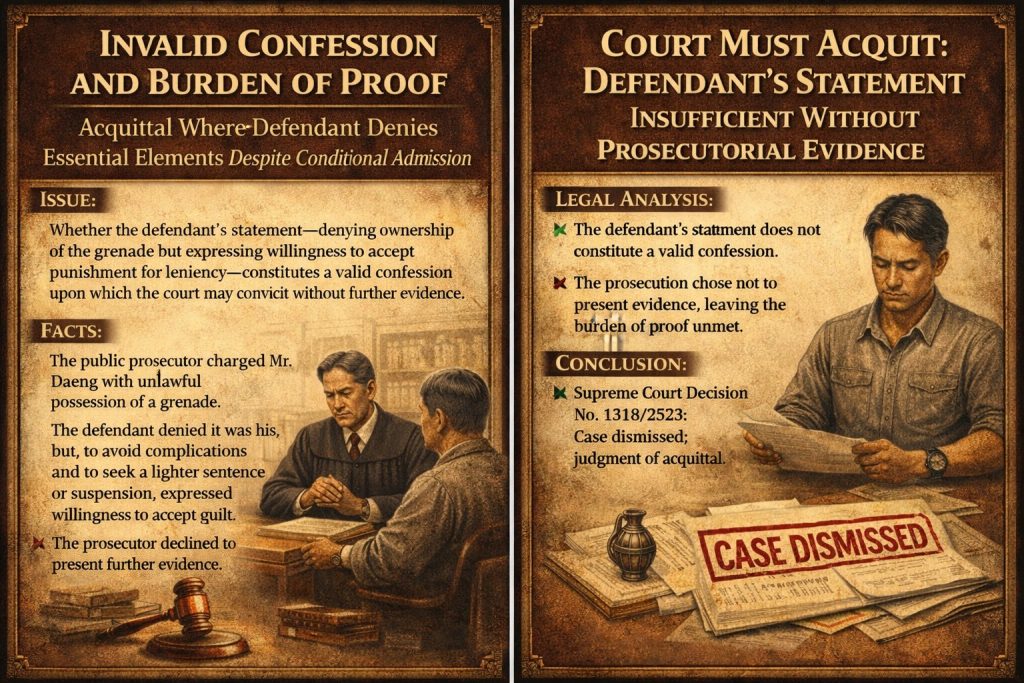
Whether the defendant’s statement—denying ownership of the grenade but expressing willingness to accept punishment for leniency—constitutes a valid confession upon which the court may convict without further evidence.
Facts:
The public prosecutor charged Mr. Daeng with unlawful possession of a grenade. The defendant submitted a statement denying that the grenade belonged to him. However, he indicated that, to avoid complications and to obtain a lighter sentence or suspension, he was willing to accept guilt. The defendant reaffirmed this position in court. The prosecutor declared no intention to present further evidence.
Legal Analysis:
Under Thai criminal procedure, a confession must be clear, unequivocal, and consistent with the charge. A statement that simultaneously denies the essential element of the offense—namely, possession—cannot be treated as a confession. The defendant’s assertion is inherently contradictory: it negates culpability while attempting to accept punishment for procedural convenience.
Such a statement lacks the legal characteristics of a valid confession and cannot serve as the sole basis for conviction. When the prosecution elects not to present evidence, the burden of proof remains unmet. The court cannot rely on an ambiguous or conditional statement to establish guilt beyond reasonable doubt.
Conclusion:
The defendant’s statement does not constitute a valid confession. In the absence of prosecutorial evidence, the court must dismiss the case and render a judgment of acquittal, consistent with Supreme Court Decision No. 1318/2523.