
Authority of an Acting Public Prosecutor Appointed by the Director-General to Institute Criminal Proceedings Without Court Notification
Issue:
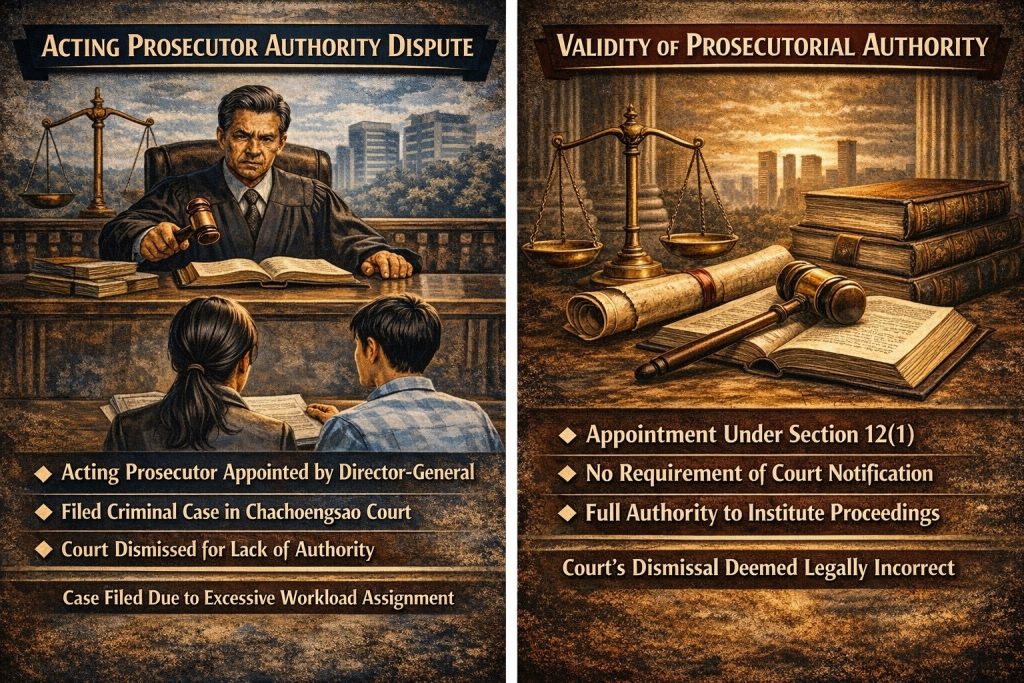
Whether a public prosecutor, appointed by the Director-General to act in the capacity of a Provincial Prosecutor, has the authority to institute criminal proceedings without prior notification to the court, and whether the court’s dismissal on the ground of lack of authority is lawful.
Rule:
Under Section 12(1) of the relevant law governing public prosecutors, the Director-General possesses the authority to appoint a public prosecutor to act or perform duties in place of another prosecutor, including acting in the position of a Provincial Prosecutor. Such appointment is an internal administrative act and does not require prior notification to the court in order to be valid.
Application:
In this case, due to an excessive workload, the Director-General assigned a public prosecutor to act as the Provincial Prosecutor of Chachoengsao. The appointed prosecutor assumed the position and subsequently filed a criminal case before the Chachoengsao Provincial Court.
The court dismissed the case on the ground that the plaintiff (prosecutor) lacked authority to prosecute.
However, the appointment by the Director-General was lawful and within statutory power. The acting prosecutor therefore had full authority to perform prosecutorial functions, including the filing of a criminal case. The absence of notification to the court does not invalidate such authority, as the law does not impose such a requirement.
Conclusion:
The judgment of the Chachoengsao Provincial Court is incorrect in law. The acting public prosecutor had lawful authority to file the case, and the dismissal on the ground of lack of authority is unjustified