
Detailed Legal Case Summary: Invalid Transfer of Leasehold Rights by a Person Without Written Authority; No Right to Revoke or Claim Damages
Detailed Legal Case Summary: Invalid Transfer of Leasehold Rights by a Person Without Written Authority; No Right to Revoke or Claim Damages
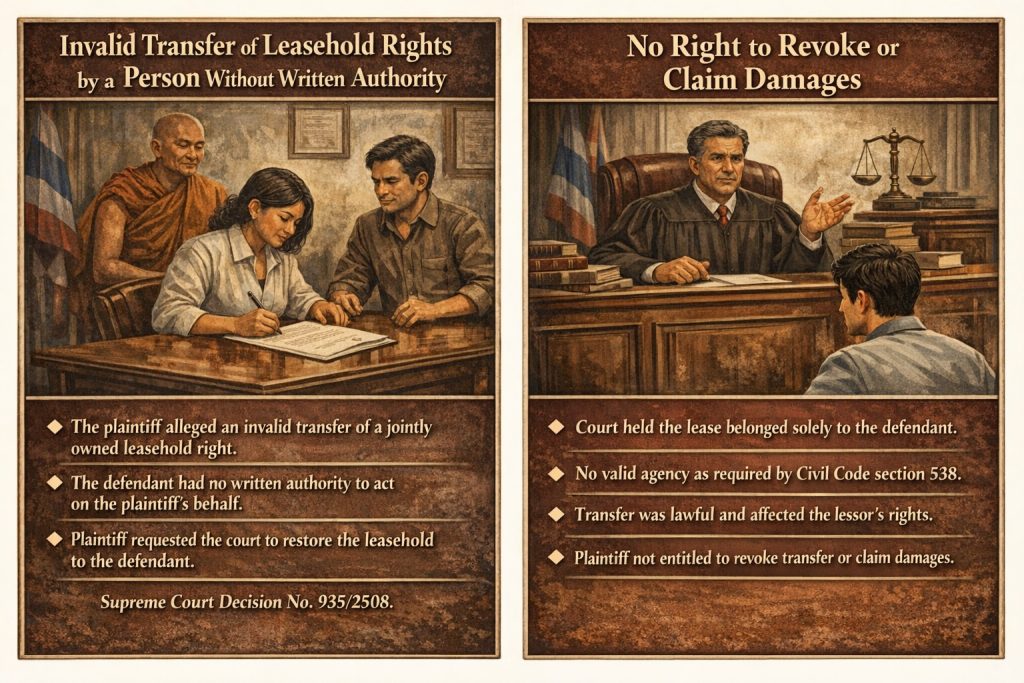
The plaintiff alleged that the leasehold right in the building was jointly owned between the plaintiff and Mrs. Ying, one of the defendants. However, Mrs. Ying executed or participated in the transfer of the leasehold right without proper authority from the plaintiff. The plaintiff argued that she had no power to dispose of or transfer the plaintiff’s interest in the lease, and therefore the transfer was unlawful and legally incomplete. The plaintiff further claimed to have rescinded such juristic act and asked the court to compel the defendants to restore or re-transfer the leasehold right to Mrs. Ying as previously held. In the alternative, the plaintiff requested that all three defendants be held jointly liable for damages in the amount of 10,000 baht, representing the plaintiff’s alleged share of the rental benefits that could otherwise have been derived from leasing the building to another party.The court dismissed the plaintiff’s claim. It held that the lease was solely the right of Mrs. Ying, the defendant, and that she did not act as the plaintiff’s agent because there was no written evidence establishing an agency relationship, as required by the Civil and Commercial Code, section 538. Since no valid written authority existed, the plaintiff could not assert that Mrs. Ying had acted on the plaintiff’s behalf in relation to the leasehold right. Furthermore, the transfer of the lease was regarded as an exercise of a lawful right, not an unlawful act. In addition, the matter affected the rights of Wat Yang, the lessor, and therefore could not be altered merely on the plaintiff’s assertion. As a result, the plaintiff had no right either to revoke the transfer or to recover damages. Accordingly, the action was dismissed in its entirety, consistent with Supreme Court Decision No. 935/2508.