
Irrevocability of a Gift Made in Performance of a Moral Duty and Enforceability of a Third-Party Benefit under Thai Civil and Commercial Law
Irrevocability of a Gift Made in Performance of a Moral Duty and Enforceability of a Third-Party Benefit under Thai Civil and Commercial Law
Jan registered a gift of an 8-rai parcel of titled land in favor of his son, Angkarn, for agricultural use. In the same registered instrument, Jan expressly stipulated that Angkarn was required to subdivide 2 rai of the said land, in accordance with the plan annexed to the agreement, and allocate that portion to Phut, Jan’s adopted son, for cultivation, with Phut bearing the expenses of subdivision. Thereafter, when Phut requested Angkarn to effect the subdivision in accordance with the agreement, Angkarn refused to do so. Phut then informed Jan, who reproached Angkarn for his refusal. In response, Angkarn uttered grossly insulting words against Jan.
The legal issue is whether Jan and Phut may recover the land, or any part thereof, from Angkarn, and on what legal basis.
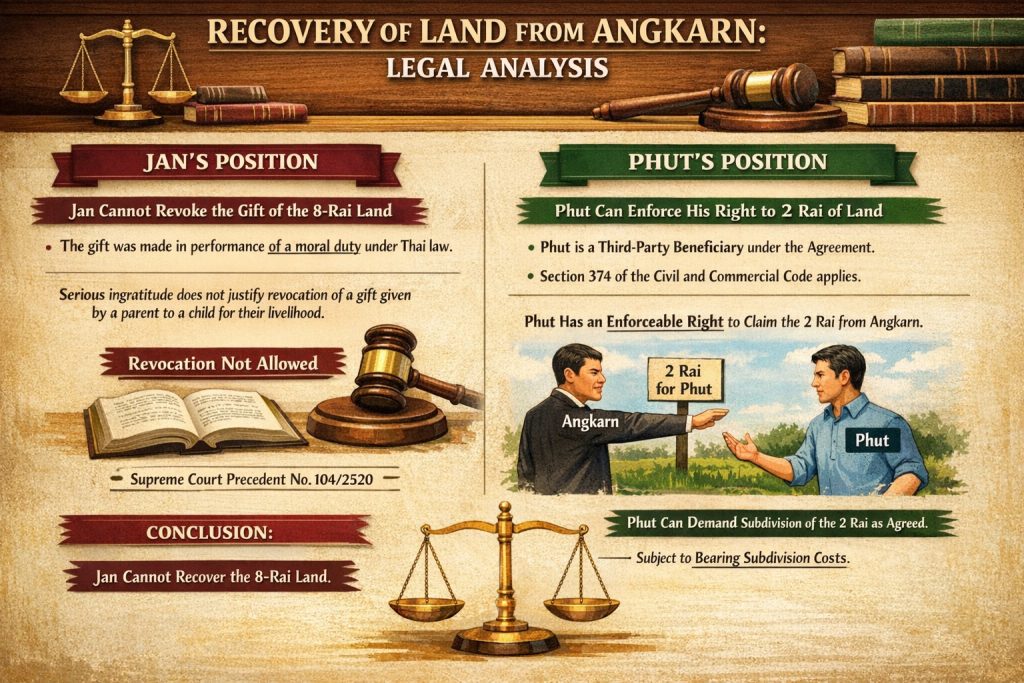
As to Jan, he is not entitled to revoke the gift and recover the land from Angkarn. Although insulting conduct by a donee may, in general circumstances, constitute a ground for revocation of a gift on the basis of serious ingratitude, such right of revocation does not apply where the gift was made in performance of a moral duty. A parent’s transfer of land to a child for the child’s livelihood and cultivation is regarded as a disposition made in discharge of such moral obligation. Accordingly, the registered gift of the 8-rai land cannot be withdrawn by Jan merely because Angkarn later insulted him. This principle is consistent with Thai Civil and Commercial law governing gifts and with Supreme Court precedent No. 104/2520.
As to Phut, however, his position is materially different. The clause in the gift agreement requiring Angkarn to subdivide and allocate 2 rai to Phut constitutes a contractual stipulation conferring a benefit upon a third party. Under Section 374 of the Civil and Commercial Code, once the third-party beneficiary has declared his intention to take the benefit under the contract, such beneficiary acquires an enforceable right directly against the promisor. In this case, Phut had already manifested his intention to accept the benefit of the 2 rai designated for him under the agreement. Consequently, Phut is legally entitled to demand performance of that stipulation from Angkarn.
Therefore, Jan has no right to revoke the gift and recover the 8-rai land from Angkarn. Phut, on the other hand, may directly enforce his right as a third-party beneficiary and claim the designated 2 rai from Angkarn in accordance with the agreement, subject to Phut’s obligation to bear the subdivision expenses as stipulated.