
Whether a Descendant of a Deceased Joint Plaintiff May Continue Criminal Proceedings in a Fraud Case
Whether a Descendant of a Deceased Joint Plaintiff May Continue Criminal Proceedings in a Fraud Case
Mr. Daeng was allegedly defrauded by Mr. Dam of 80,000 baht. Mr. Daeng initially lodged a criminal complaint with the inquiry official. Thereafter, criminal proceedings were commenced against Mr. Dam. The Court of First Instance convicted the defendant, but the Court of Appeal reversed the judgment and dismissed the case. Mr. Daeng then filed an appeal to the Supreme Court. While that appeal was pending, the public prosecutor instituted a separate criminal action against Mr. Dam based on the same facts. Mr. Daeng subsequently withdrew his own case in order to join the prosecutor’s case as a co-plaintiff, and the court granted such request.
After the prosecution and defense had completed the taking of evidence, Mr. Daeng fell ill and later died. Mr. Khiao, who claimed to be Mr. Daeng’s son born of a non-registered marriage, filed a motion seeking leave to substitute for Mr. Daeng and continue the case as a co-plaintiff alongside the public prosecutor. The defendant objected.
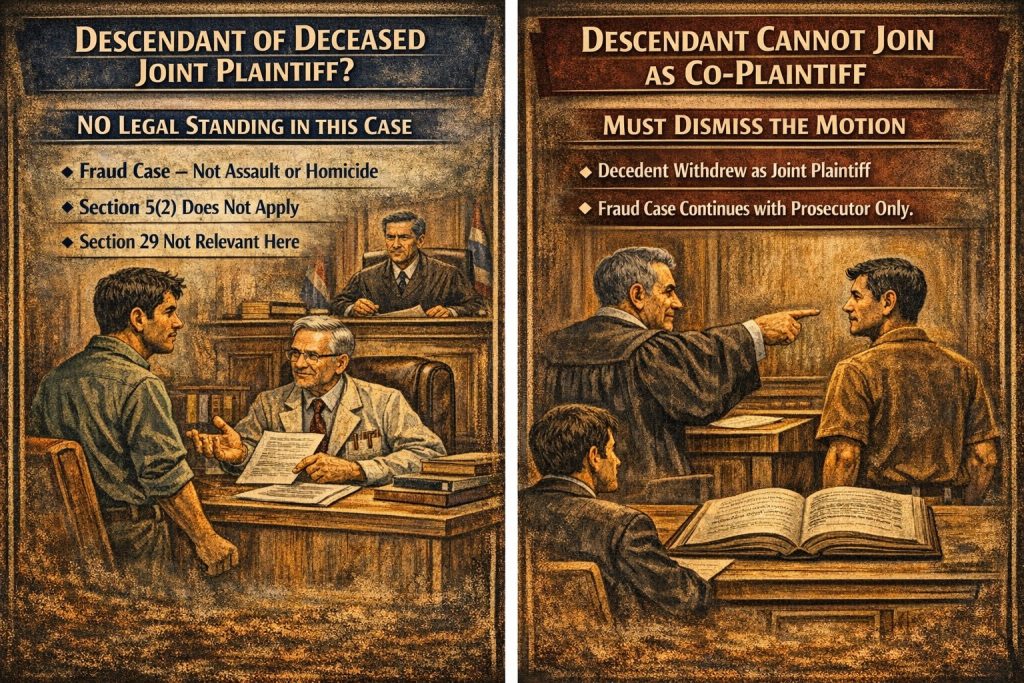
If sitting as the court, the proper ruling would be to dismiss Mr. Khiao’s application. Even assuming that Mr. Khiao is a descendant of Mr. Daeng, he is not entitled to enter the proceedings as a co-plaintiff in this case. The reason is that this matter concerns fraud, namely a property offense causing pecuniary loss, and is not a case in which the injured person was assaulted or killed so as to bring the matter within the scope of section 5(2) of the Thai Criminal Procedure Code. Therefore, the statutory basis allowing certain relatives or descendants to act in place of the injured person does not apply here.
Nor can Mr. Khiao rely on section 29 of the Criminal Procedure Code. That provision does not extend to the present circumstances merely because the original injured person later died after having once initiated proceedings. In this case, Mr. Daeng had already withdrawn his own action and thereafter participated only as a joint plaintiff with the public prosecutor. His death did not create a new right for his descendant to be substituted into that status in an ordinary fraud prosecution.
Accordingly, the court should hold that Mr. Khiao has no legal standing to join or continue the criminal proceedings as co-plaintiff with the public prosecutor, and his motion must therefore be deni