
Criminal Proceedings in a Case of Negligent Homicide
Criminal Proceedings in a Case of Negligent Homicide
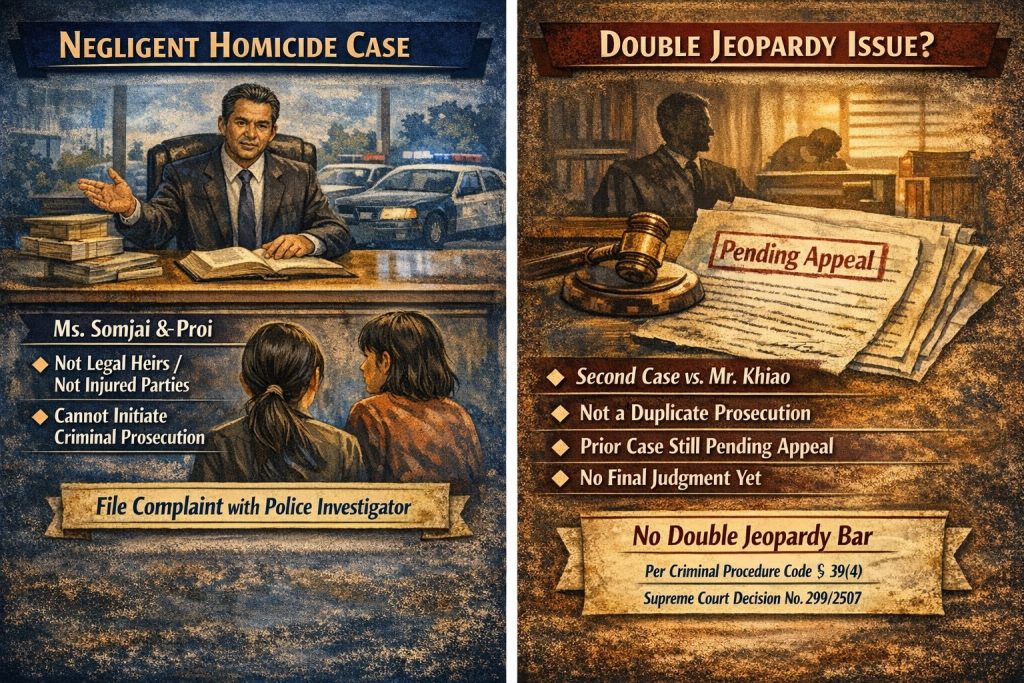
Ms. Somjai, aged 17, had been cohabiting as husband and wife with Mr. Somjit, aged 19, without marriage registration, and they had no children together. Both of them had no surviving parents or relatives, all having passed away. They therefore took a girl, “Proi,” from a hospital and raised her as an adopted child. One day, Mr. Somjit was struck and killed through the negligent driving of Mr. Somnuek. Ms. Somjai and the girl Proi then consulted as to what criminal proceedings, if any, could be brought against Mr. Somnuek.
Answer:
Ms. Somjai is not a lawful wife because the relationship was not registered under marriage law. Therefore, she is not an injured person with authority to independently institute a criminal prosecution on that basis. As for the girl Proi, she is not a descendant of Mr. Somjit and therefore is likewise not an injured person in the legal sense. The proper advice is that the matter should be reported to the inquiry officer/police investigator by filing a complaint, so that criminal proceedings may be pursued through the ordinary prosecutorial process.
Issue 4: Whether a Subsequent Prosecution Constitutes Double Jeopardy / a Duplicate Action
The public prosecutor filed a criminal case against Mr. Khiao for causing grievous bodily harm. However, because the prosecutor’s indictment was defective, the court dismissed the case. During that period, Mr. Lueang, the injured person, filed a separate criminal action against Mr. Khiao for attempted murder. Upon preliminary examination, the court found that the case had a prima facie basis. In the second case, Mr. Khiao objected, arguing that it was a duplicate action.
Answer:
The second action is not a duplicate action. This is because the earlier case brought by the public prosecutor was still pending on appeal and had not yet reached final judgment. Therefore, there had not yet been a final adjudication of the offence within the meaning of Section 39(4) of the Criminal Procedure Code. Accordingly, the later case filed by the injured person is not barred as a prohibited duplicate prosecution. This principle is supported by Supreme Court precedent, e.g. Supreme Court Decision No. 299/2507.